Setting Sail on Your Civic Literacy Journey
If you sit down to prepare for your own civic education assessments , the sheer volume of legal cases, constitutional amendments, and government structures will feel completely overwhelming.
First, you will start with hundreds of pages of dense text, wondering how these abstract historical concepts are connected to the actual exam questions.
That personal struggle will teach you a vital lesson: success in civic literacy does not require memorizing an entire law library in a single night.
FCLE in particular, getting the grip requires building a scaffold-ed, step-by-step understanding of how American government functions from the top down.
The Architecture and Requirements
The Florida Civic Literacy Examination is a computer-based assessment. The examination is designed to evaluate a learner's fundamental understanding of American democracy and government institutions. Public Florida colleges and universities require Postsecondary students to demonstrate competency in civic literacy. This is done through coursework and passing this standardized assessment. Understanding the test blueprint before diving into individual study topics is important . It prevents wasted effort and keeps your study schedule aligned with actual test weightings.
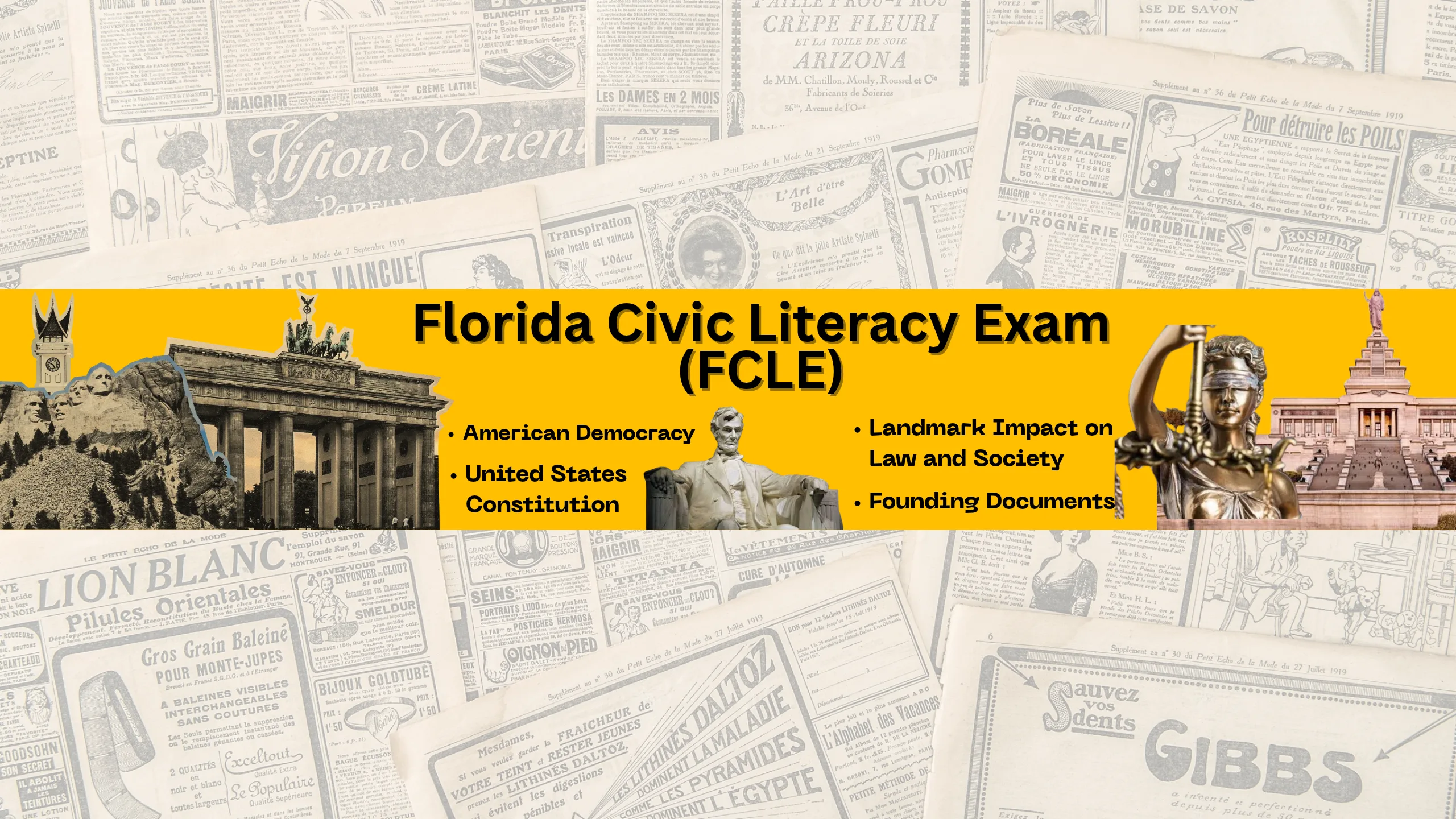
The state structures the FCLE around four categories. All categories are equally weighted in terms of knowledge , each making up approximately 25% of the overall examination pool. These categories build directly upon one another. Basically taking you from basic institutional structures to complex legal interpretations.
Understanding this four-part structure allows you to diagnose your strengths and weakness early in your review process. You will realize quickly that while I understood basic government branches, landmark court cases required far deeper analysis.
1. American Democracy and Government Institutions.
The first core pillar focuses on the mechanics and organization of the United States government system. You must understand 3 things.
- How power flows through federalism
- How the three branches interact
- How citizens participate in local,state and national civic life.
This section tests your grasp of representative democracy versus direct democracy, electoral processes, and the explicit duties assigned to political leaders.
Each branch under Articles I, II, and III of the U.S. The Constitution is granted specific check-and-balance powers. Knowing that Congress passes legislation is basic. Knowing that the Senate holds exclusive authority to ratify treaties and confirm executive appointments is where FCLE questions live.
American Democracy and Government Institutions analyses on how citizens influence their government through voting,political parties and interest groups . You will learn the exact steps of the naturalization process, the legal responsibilities of United States citizenship, and how federalism divides authority between Tallahassee and Washington, D.C.
2. Constitutional Principle and Rules of Law
The focus here is the foundational legal rules and governing philosophy that constrain government power. The FCLE subjectively focuses on core ideals such as the Rule of Law, limited government,popular sovereignty, and individual liberty. Knowing how the U.S. The Constitution protects individual rights against arbitrary government action,as a learner, through due process and equal protection principles is important.
When studying for my own civic education milestones, I found it helpful to view the Bill of Rights as specific shields forged to prevent historical government abuses.
The First Amendment safeguards fundamental freedoms of speech, assembly, press, petition, and religion.
The Fourth to the Eighth Amendments safeguard the rights of the accused during judicial proceedings. Putting these legal protections to real-life scenarios enhances retaining complex constitutional principles simple.
This category requires a better and detailed understanding of the constitutional amendment process detailed in Article V. You will understand how rights evolved over time through the Civil War Reconstruction Amendments—specifically the 14th Amendment's Equal Protection Clause—and voting expansion amendments like the 19th and 26th. Grasping these constitutional shifts sets the perfect stage for examining how the judicial branch interprets these rights in practice.
3.Supreme Court Landmark Cases
This category applies constitutional theory to legal reality through the study of Supreme Court jurisprudence(study or philosophy of law. ). As a civic education professional I would recommend focusing on specifics- familiarity with landmark judicial decisions that shaped American society, defined federal power, and expanded individual civil rights. Memorizing case names is not enough; you must understand the constitutional questions, rulings, and lasting legal precedents established by the Court.
Case Name | Year | Primary Constitutional Issue | Significance |
|---|---|---|---|
2023 | Equal Protection Clause / 14th Amendment | Struck down race-conscious affirmative action in university admissions programs, ruling that higher education institutions must evaluate applicants individually. | |
2024 | Eighth Amendment / Cruel & Unusual Punishment | Ruled that municipal bans on unhoused individuals sleeping outdoors with basic bedding do not constitute cruel and unusual punishment. | |
2022 | Right to Keep & Bear Arms / 2nd Amendment | Expanded public carry rights, establishing a constitutional standard requiring gun restrictions to align with historical regulatory traditions. |
When reviewing court cases, organize them by constitutional principle rather than dates. Grouping Gideon v. Wainwright, Miranda v. Arizona, and Mapp v. Ohio under "Rights of the Accused" is a good example..
McCulloch v. Maryland and Gibbons v. Ogden explores how the Supreme Court's interpretation of federal power evolved. Brown v. Board of Education covers student rights precedents and civil rights decisions . United States v. Nixon covering executive privilege limits.
4.Foundational Documents and Primary Sources
The final core domain tests your ability to read, analyze, and interpret primary historical sources that shaped American civic literacy. FCLE presents direct excerpts from historical speeches breaking the norm of relying on textbook summaries, foundational essays, and legal charters. You must identify key arguments, author intentions, and core political philosophy within these seminal American texts.
In this category reading primary sources excerpts like Federalist No. 51,Declaration of Independence - is key. You need to spot phrases and core themes quickly. Spotting James Madison's phrase unlocks the entire essay's argument regarding checks and balances - "ambition must be made to counteract ambition" .
FREQUENTLY ASKED QUESTIONS
1. Which was the first written framework of democratic government in the colonies that established majority rule? (Founding Documents)
This question tests your knowledge of early colonial self-governance and the foundations of American democracy. The Mayflower Compact is a landmark document because it was the first instance where colonists agreed to govern themselves through majority rule, rather than being ruled by a monarch or external authority. The Pilgrims, who were Separatists seeking religious freedom, landed outside the jurisdiction of the Virginia Company, so they needed a framework to maintain order and prevent factionalism. The compact was a social contract, inspired by the Puritan covenant theology, where each signer pledged to submit to the will of the majority for the sake of the community's survival. This concept of a covenant, or mutual agreement, was deeply rooted in their religious beliefs and translated into a political structure that emphasized equality and collective decision-making. The Mayflower Compact is often seen as a precursor to later democratic documents like the Declaration of Independence and the U.S. Constitution, as it established the principle that government derives its authority from the consent of the governed. In the context of the Florida Civic Literacy Exam, understanding this document is crucial because it illustrates the early development of self-government in the colonies, which eventually led to the American Revolution and the creation of a republican form of government.The compact also highlights the importance of majority rule, a fundamental principle in democratic systems, and contrasts with other historical events like the Halfway Covenant, which was a religious compromise, and the Northwest Ordinance, which was a later law for territorial governance.
2. Which was a cause of the American Revolution? (American Democracy)
The American Revolution (1775–1783) was not a sudden event but the culmination of decades of growing tension between the British Crown and its thirteen North American colonies. Central to this conflict was the issue of taxation without representation. After the costly French and Indian War (1754–1763), Britain sought to recoup its expenses by imposing a series of direct taxes on the colonies, such as the Stamp Act of 1765 and the Townshend Acts of 1767. The colonists, who had long enjoyed a degree of self-governance through their colonial assemblies, argued that only their own elected representatives had the right to tax them. This principle, famously summarized as 'no taxation without representation,' was rooted in the English constitutional tradition and the rights of Englishmen, which the colonists believed extended to them. The cry became a unifying force, leading to organized protests, boycotts of British goods, and events like the Boston Tea Party in 1773. In response, Britain enacted the Coercive Acts (Intolerable Acts) in 1774, which further restricted colonial liberties and prompted the convening of the First Continental Congress. This congress sought to address grievances through petitions, but when these were rejected, the path toward armed conflict and eventual independence became inevitable. The Declaration of Independence in 1776, authored primarily by Thomas Jefferson, enumerated these grievances, including taxation without consent, as justification for breaking away from British rule. The revolution thus established the foundational American principle that legitimate government derives its power from the consent of the governed, a concept that would later shape the U.S. Constitution and Bill of Rights.
3. Which constitutional authority would allow the president to use military force in response to an invasion? (The U.S. Constitution.)
This question tests your understanding of the separation of powers and the specific constitutional roles of the President of the United States, a key concept in the Florida Civic Literacy Exam. The U.S. Constitution deliberately distributes war powers between the executive and legislative branches to balance efficiency with democratic deliberation. Article I grants Congress the power to declare war, raise and support armies, and provide for the common defense, reflecting the Founders' fear of concentrating military authority in one person. However, Article II designates the President as Commander in Chief of the Army and Navy, a role that implies operational control over military forces once they are raised. This division creates a dynamic tension: Congress decides whether the nation enters a state of war, but the President directs how military operations are conducted. In practice, this has led to numerous conflicts where presidents have used their commander-in-chief authority to deploy troops without a formal declaration of war, such as in Korea, Vietnam, and more recent engagements. The War Powers Resolution of 1973 attempted to check presidential power by requiring congressional notification and approval for prolonged military actions, but its effectiveness remains debated. For the FCLE, understanding this balance is crucial, as questions often ask which branch holds specific powers or how the Constitution addresses national emergencies. The correct answer here focuses on the President's direct constitutional authority to respond to an invasion, which is a defensive action inherent in the commander-in-chief role. This authority is not unlimited, but it clearly empowers the President to act swiftly to repel an attack, as seen in historical examples like the Cuban Missile Crisis or the response to 9/11. The question also highlights the importance of distinguishing between the power to initiate war (Congress) and the power to conduct war (President), a distinction that is fundamental to American constitutional governance.
Civic literacy knowledge equips you to participate in American democracy. Institutional roles, landmark rulings, constitutional principles, and primary source documents builds foundation that serves you beyond the test center.Take each concept step by step, connect historic principles to current scenarios, and approach every topic with active curiosity.