Tackling Competency 1: Understanding of the basic principles and core values of American democracy is your first major step toward passing the FCLE exam with confidence.
1. Where It All Began: Enlightenment Philosophy & Natural Rights
Before the United States had a constitution, a president, or even a flag, it had an idea. That idea didn't appear out of thin air; it was forged during the European Enlightenment. This was a 18th-century intellectual movement that questioned traditional authority and centered on reason, individual liberty, and governance.
To ace FCLE Competency 1, you must know three key thinkers whose theories laid the foundation for American democracy:
John Locke and Natural Rights
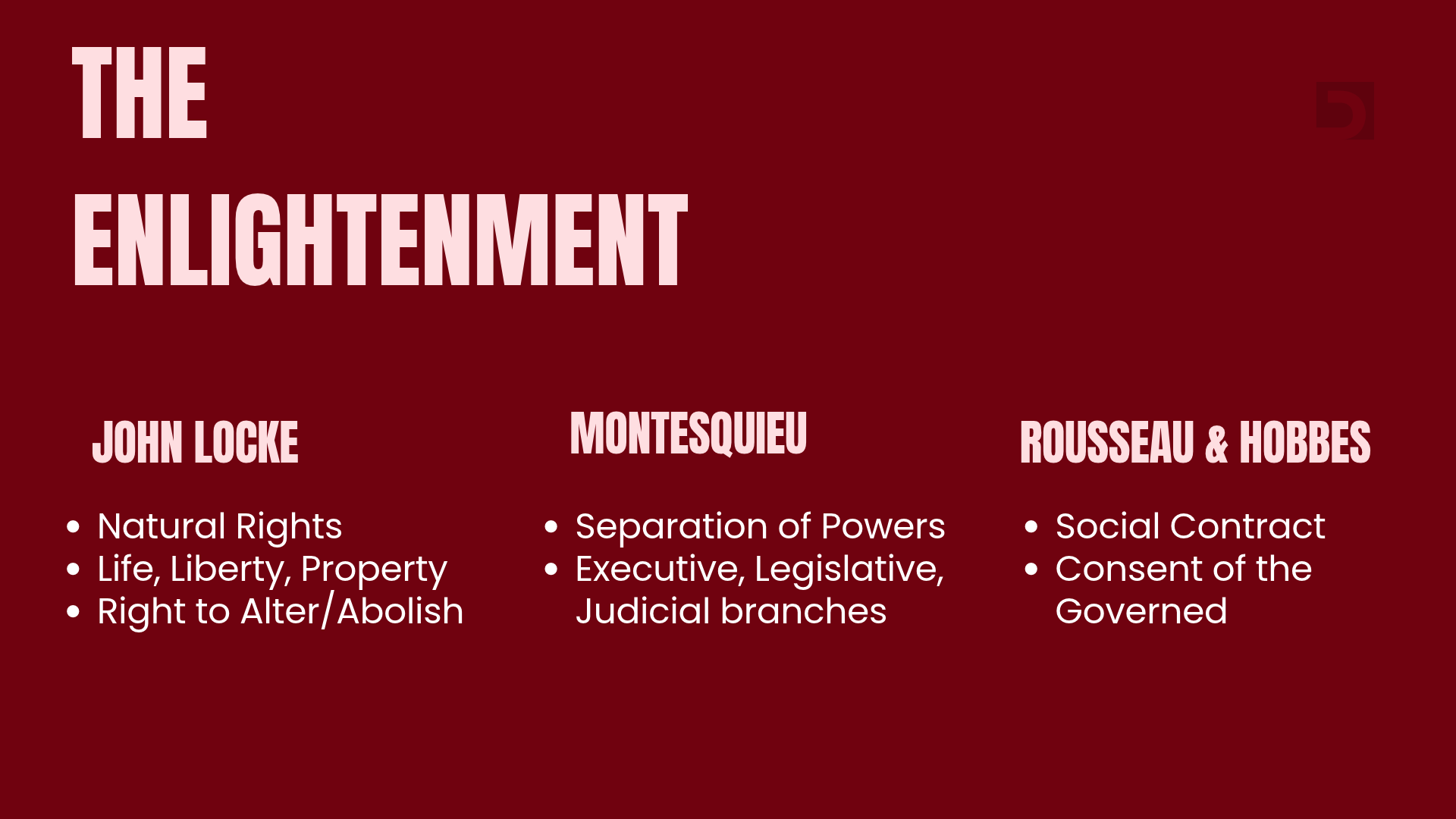
In his Second Treatise of Government (1689), John Locke argued that all human beings are born with inherent, fundamental rights that no ruler can take away.
He defined these Natural Rights as:
-Life: The right to exist safely without fear of harm.
-Liberty: The freedom to act and think without arbitrary constraint.
-Property: The right to own land, goods, and the fruits of one's labor.
Locke popularized the Social Contract Theory: the belief that people voluntarily give up a small portion of their total freedom to a government in exchange for the protection of their natural rights. However, Locke emphasized a crucial condition—Consent of the Governed. If a government becomes tyrannical and fails to protect these rights, the people have a moral and legal right to alter or abolish it.
Sound familiar? Thomas Jefferson directly borrowed Locke's philosophy when writing the Declaration of Independence in 1776, adapting "property" to "the pursuit of Happiness."
Baron de Montesquieu and the Separation of Powers
How do you prevent a government from growing so powerful that it tramples on natural rights? French philosopher Baron de Montesquieu supplied the answer in The Spirit of the Laws (1748).
Montesquieu observed that concentrating legislative, executive, and judicial authority in a single person or group leads directly to despotism.
He proposed dividing government authority into three distinct branches:
-Legislative Branch: Writes and enacts laws.
-Executive Branch: Enforces and administers laws.
-Judicial Branch: Interprets laws and resolves disputes.
This principle became the structural backbone of the U.S. Constitution (Articles I, II, and III).
Jean-Jacques Rousseau and Thomas Hobbes
-Thomas Hobbes: In Leviathan (1651), Hobbes argued that without government, human life in a "state of nature" would be "solitary, poor, nasty, brutish, and short." While he advocated for a strong sovereign to maintain order, he helped pioneer early social contract thought.
-Jean-Jacques Rousseau: In The Social Contract (1762), Rousseau championed Popular Sovereignty—the idea that legitimate political authority rests entirely in the hands of the people, governed by the "general will."
2. Foundational Historical Documents: The Steps to 1787
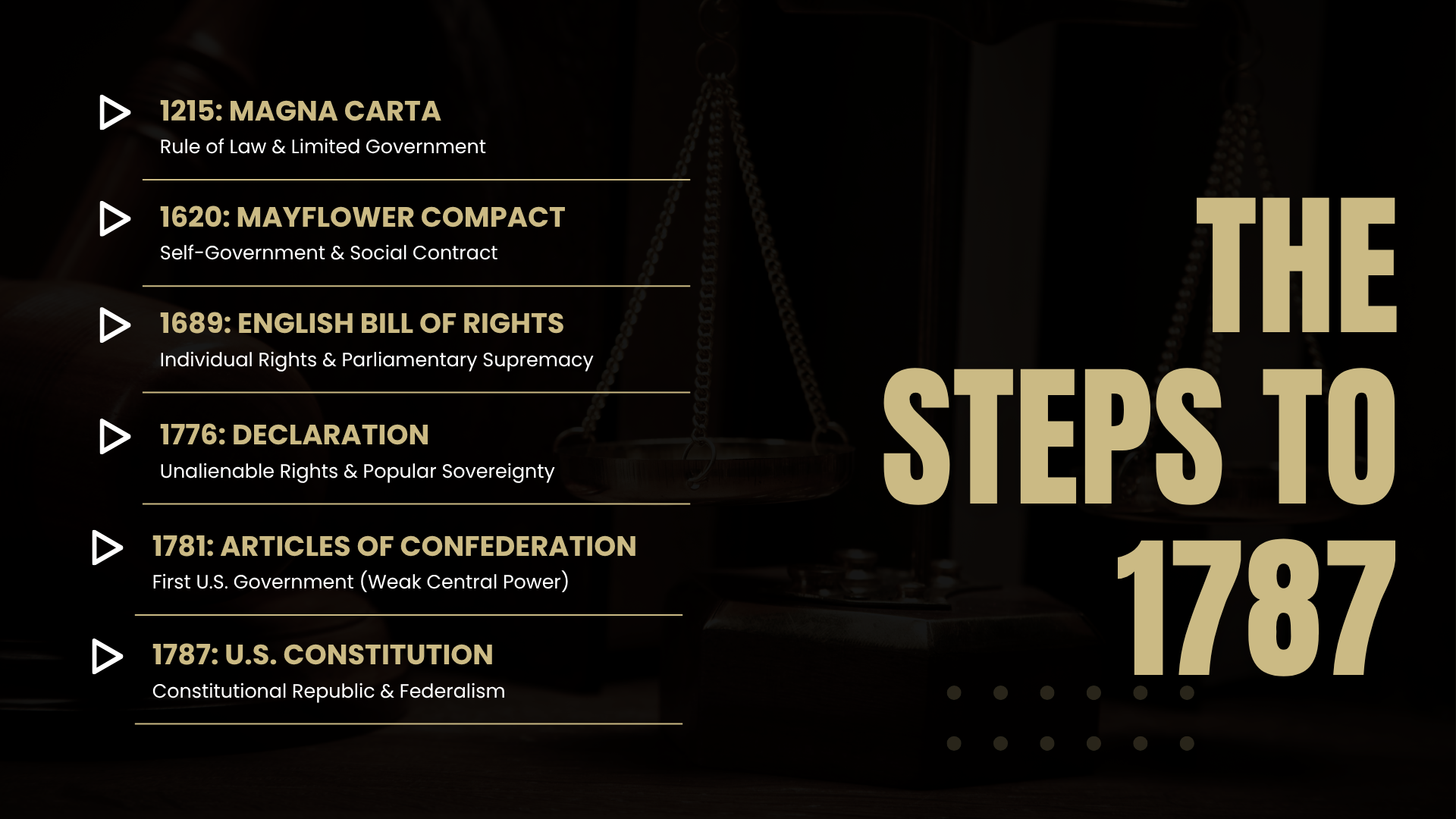
American constitutional democracy was built step-by-step over hundreds of years. The FCLE frequently tests your ability to match historical documents with the principles they introduced into American law.
1. Magna Carta (1215)
When English barons forced King John to sign the Magna Carta (Great Charter) at Runnymede in 1215, they established a monumental precedent: Rule of Law. For the first time in written legal history, it was explicitly stated that the monarch was not above the law. It introduced early concepts of due process, protection against arbitrary imprisonment, and limits on monarchical power.
2. Mayflower Compact (1620)
Before stepping off their ship at Plymouth Rock, 41 Pilgrim men signed the Mayflower Compact. Recognizing they were landing outside their original charter's territory, they pledged to combine themselves into a "Civil Body Politick" and enact "just and equal Laws." This brief document represents the first legal framework for self-government and direct majority rule created in the American colonies.
3. English Bill of Rights (1689)
Following the Glorious Revolution, Parliament enacted the English Bill of Rights, permanently curtailing royal power. It guaranteed crucial individual rights, including freedom of speech within Parliament, the right to petition the monarch, protections against excessive bail, and prohibition of "cruel and unusual punishments"—phrases that were copied almost word-for-word into the U.S. Bill of Rights a century later.
4. Declaration of Independence (1776)
Drafted primarily by Thomas Jefferson, the Declaration of Independence severed political ties between the Thirteen Colonies and Great Britain. It stands as America's ultimate philosophical manifesto, proclaiming two key tenets:
All individuals possess unalienable rights (Life, Liberty, and the pursuit of Happiness).
Governments derive their "just powers from the consent of the governed."
3. From Weakness to Strength: Articles of Confederation vs. U.S. Constitution
A common topic on FCLE Competency 1 is understanding why America’s first attempt at self-governance failed and how the U.S. Constitution fixed those systemic flaws.
The Articles of Confederation (1781–1789)
During the Revolutionary War, the Continental Congress created America's first constitution: the Articles of Confederation. Fearing royal tyranny, the Framers deliberately created an intentionally weak national government—a loose "league of friendship" among 13 sovereign states.
Feature | Articles of Confederation | U.S. Constitution (1787) |
Structure | Unicameral Legislature (One vote per state) | Bicameral Congress (House & Senate) |
Executive Branch | None (No President to enforce laws) | President & Executive Department |
Judicial Branch | None (No national courts to resolve state disputes) | Supreme Court & Federal Judiciary |
Taxing Power | Could only request money from states | Power to lay and collect taxes directly |
Commerce Control | No power to regulate interstate trade | Interstate Commerce Clause |
Amendment Process | Required unanimous consent (All 13 states) | 2/3 of Congress + 3/4 of States |
Shays' Rebellion (1786–1787)
In late 1786, war veteran Daniel Shays led an armed uprising of desperate Massachusetts farmers protesting foreclosures and debt collection. Because the national government had no authority to raise a standing army or tax citizens to pay soldiers, it could not intervene. Shays' Rebellion exposed the dangerous vulnerability of the Articles of Confederation, convincing national leaders like George Washington and Alexander Hamilton that a Constitutional Convention was urgently necessary.
The Constitutional Ratification Debate: Federalists vs. Anti-Federalists
At the Philadelphia Convention of 1787, delegates scrapped the Articles entirely and wrote the U.S. Constitution. However, ratifying it required approval from 9 of the 13 states, triggering a nationwide debate:
-The Federalists: Led by Alexander Hamilton, James Madison, and John Jay. Writing under the pseudonym Publius, they published The Federalist Papers (notably Federalist No. 10 on factions and Federalist No. 51 on checks and balances). They argued that a strong, energetic central government was essential to preserve order, protect property, and defend the nation.
-The Anti-Federalists: Led by Patrick Henry, George Mason, and Richard Henry Lee (authoring papers like Brutus I). They feared a powerful national executive and federal court system would destroy state sovereignty and individual rights. They agreed to ratify the Constitution only after Federalists promised to add a written Bill of Rights (the first 10 amendments) as its first act of business.
4. Core Mechanics of American Democracy
To score high on FCLE Competency 1, you must understand how these six constitutional principles function in everyday governance:
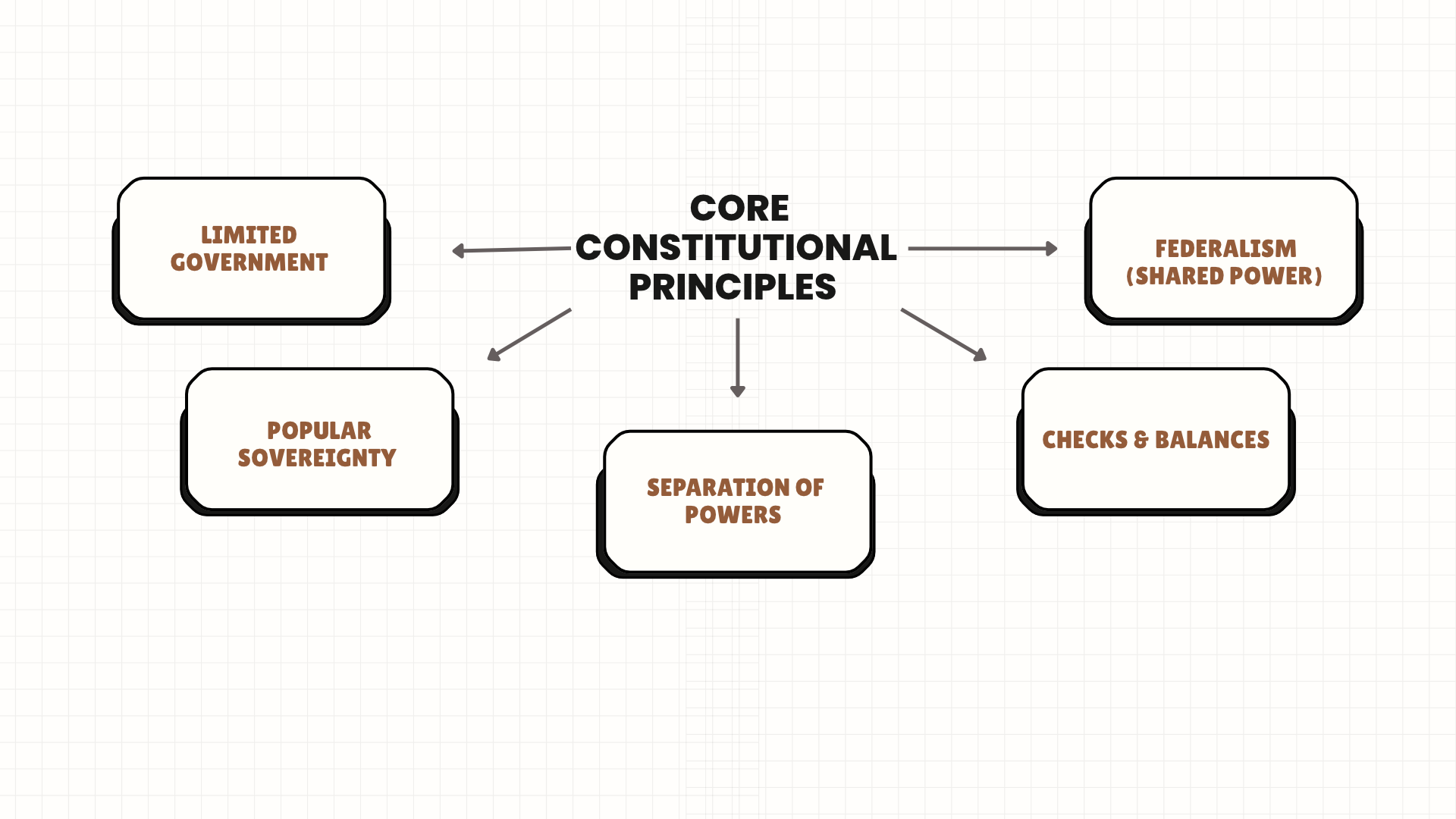
1. Popular Sovereignty
Definition: Ultimate political authority belongs to the people.
How it works: Citizens exercise their sovereignty by voting for representatives in free elections. The opening phrase of the Constitution "We the People" encapsulates this principle.
2. Limited Government
Definition: Government power is not absolute; it is bounded by law and the Constitution.
How it works: Government officials are subject to the same legal restrictions as ordinary citizens. Specific prohibitions (e.g., Article I, Section 9) explicitly restrict what Congress can and cannot do.
3. Separation of Powers
Definition: Dividing the duties of government into three distinct, independent branches.
-Legislative (Article I): Congress (House of Representatives and Senate) makes laws.
-Executive (Article II): The President enforces laws.
-Judicial (Article III): The Federal Courts interpret laws.
4. Checks and Balances
Definition: Mechanisms allowing each branch of government to restrain or override actions of the other two branches to prevent any single branch from dominating.
Examples of Checks and Balances:
Legislative over Executive: Congress can override a presidential veto with a 2/3 vote in both houses; the Senate confirms presidential appointments and treaties; the House can impeach a president.
Executive over Legislative: The President can veto bills passed by Congress; the President serves as Commander-in-Chief.
Judicial over both: The Supreme Court exercises Judicial Review (established in Marbury v. Madison, 1803) to declare acts of Congress or executive actions unconstitutional.
5. Federalism
Definition: A system of government where power is constitutionally divided between a central national government and regional state governments.
Expressed / Enumerated Powers: Powers explicitly granted to the federal government (e.g., declaring war, coining money, maintaining armed forces, regulating interstate trade).
Reserved Powers (10th Amendment): Powers retained entirely by the states (e.g., conducting elections, regulating public education, establishing marriage laws, issuing professional licenses).
Concurrent Powers: Powers shared simultaneously by national and state governments (e.g., collecting taxes, building roads, establishing court systems, borrowing money).
6. Rule of Law and Due Process
Definition: The legal principle that law should govern a nation, as opposed to being governed by arbitrary decisions of individual government officials.
Due Process (5th & 14th Amendments): Guarantees that the government must follow fair, established procedures before depriving any person of life, liberty, or property.
5. FCLE Competency 1 Practice Quiz
Test your mastery with these 5 practice questions patterned directly after official Florida Civic Literacy Examination items.
Question 1
Which Enlightenment philosopher's theory of natural rights directly influenced the writing of the Declaration of Independence?
A) Thomas Hobbes
B) John Locke
C) Baron de Montesquieu
D) Jean-Jacques Rousseau
Correct Answer: B
John Locke formulated the concept of natural rights (life, liberty, and property) in his Second Treatise of Government. Thomas Jefferson drew heavily on Locke's ideas when drafting the Declaration of Independence in 1776, adapting the phrase to "life, liberty, and the pursuit of happiness."
Question 2
How did the U.S. Constitution address the financial weaknesses of the Articles of Confederation?
A) By granting individual states the sole authority to coin money.
B) By giving Congress the explicit authority to lay and collect taxes.
C) By establishing a national bank managed by the Executive Branch.
D) By requiring unanimous approval from state legislatures for budget bills.
Correct Answer: B
Under the Articles of Confederation, the federal government had no power to tax directly and could only request funds from states. Article I, Section 8 of the U.S. Constitution remedied this flaw by granting Congress the expressed power to levy and collect taxes.
Question 3
Which historical document first established the principle that the monarch's power was not absolute, laying the groundwork for the Rule of Law?
A) Mayflower Compact (1620)
B) Declaration of Independence (1776)
C) Magna Carta (1215)
D) English Bill of Rights (1689)
Correct Answer: C
Signed in 1215, the Magna Carta limited the absolute power of the English king, establishing the foundational democratic principle that everyone—including rulers—is subject to the rule of law.
Question 4
When the President vetoes a bill passed by Congress, which core constitutional principle is being demonstrated?
A) Federalism
B) Popular Sovereignty
C) Checks and Balances
D) Due Process of Law
Correct Answer: C
The presidential veto is a primary example of checks and balances, allowing the Executive Branch to restrain the legislative power of Congress.
Question 5
Under the U.S. Constitution, which of the following is a reserved power belonging exclusively to state governments?
A) Coining currency
B) Declaring war
C) Establishing public school systems
D) Regulating foreign commerce
Correct Answer: C
Under the 10th Amendment, powers not granted to the federal government nor prohibited to the states are reserved to the states. Regulating public education, issuing licenses, and conducting elections are classic examples of reserved state powers.
As you continue your preparation for the Florida Civic Literacy Exam, keep these three study habits in mind:
Focus on Cause and Effect: Don't just memorize dates. Understand why Shays' Rebellion led to the Constitutional Convention, or why Anti-Federalists demanded a Bill of Rights.
Learn Key Terms in Context: Match terms like Federalism, Separation of Powers, and Checks and Balances directly to real-world government actions.
Connect History to Today: Knowing how natural rights and due process protect you today makes retaining this information much easier—and much more rewarding!
Competency 1 focuses on history, political philosophy, core documents, and constitutional mechanics.