Master the Florida Civic Literacy Exam: The Ultimate Practice Guide and Question Breakdown
Passive reading of historical documents is rarely enough to guarantee a passing score. Success on the FCLE requires active, targeted FCLE exam practice: learning to analyze primary source excerpts, evaluate constitutional scenarios, and master the specific question patterns used by test designers.
Section 1: FCLE Practice Essentials & Format Breakdown
You must understand the rules, mechanics, and structural layout of the assessment.
Test Parameters & Scoring
Total Questions: 80 multiple-choice items.
Passing Score: 60% or higher, which equates to answering at least 48 out of 80 questions correctly.
Format & Administration: Computer-based assessment delivered via public postsecondary testing portals across Florida College System (FCS) and State University System (SUS) institutions.
Time Allowance: Untimed in practice, though most testing centers schedule 120 to 160 minutes for completion.
The Four Domain Competencies
The Florida Department of Education (FLDOE) distributes test items across four core content pillars:
Domain Competency | Weight & Question Target | Key Focus Areas |
1. American Democracy Principles | ~25% (20 Questions) | Constitutional democracy, republicanism, popular sovereignty, rule of law, civil discourse. |
2. U.S. Constitution & Mechanics | ~25% (20 Questions) | Separation of powers, checks and balances, the 27 Amendments, federalism, institutional roles. |
3. Founding Documents & Context | ~25% (20 Questions) | Declaration of Independence, Federalist Papers (No. 10 & 51), Anti-Federalist arguments, Articles of Confederation. |
4. Landmark Supreme Court Cases | ~25% (20 Questions) | Judicial review, equal protection, due process, First Amendment protections, rights of the accused. |
The Three FCLE Question Styles
When practicing, you will encounter three distinct item formats:
Direct Knowledge Recall: Straightforward factual prompts that assess your core memory of constitutional mechanics, historical milestones, and explicit legal rules e.g., Which amendment granted women the right to vote?
Primary Source & Excerpt Analysis: Text-based prompts featuring direct quotes from foundational documents such as the U.S. Constitution or The Federalist Papers requiring you to identify the author, document, or underlying political philosophy.
Applied Scenario Questions: Case-based prompts presenting hypothetical real-world situations e.g., a student-led protest or a warrantless police search that test your ability to apply constitutional principles and landmark Supreme Court precedents.
Section 2: The Diagnostic Phase – Establishing Your Baseline
The biggest mistake students make is diving into flashcards without assessing where their actual knowledge gaps lie. Effective preparation begins with diagnostic profiling.
How to Run Your Diagnostic Session
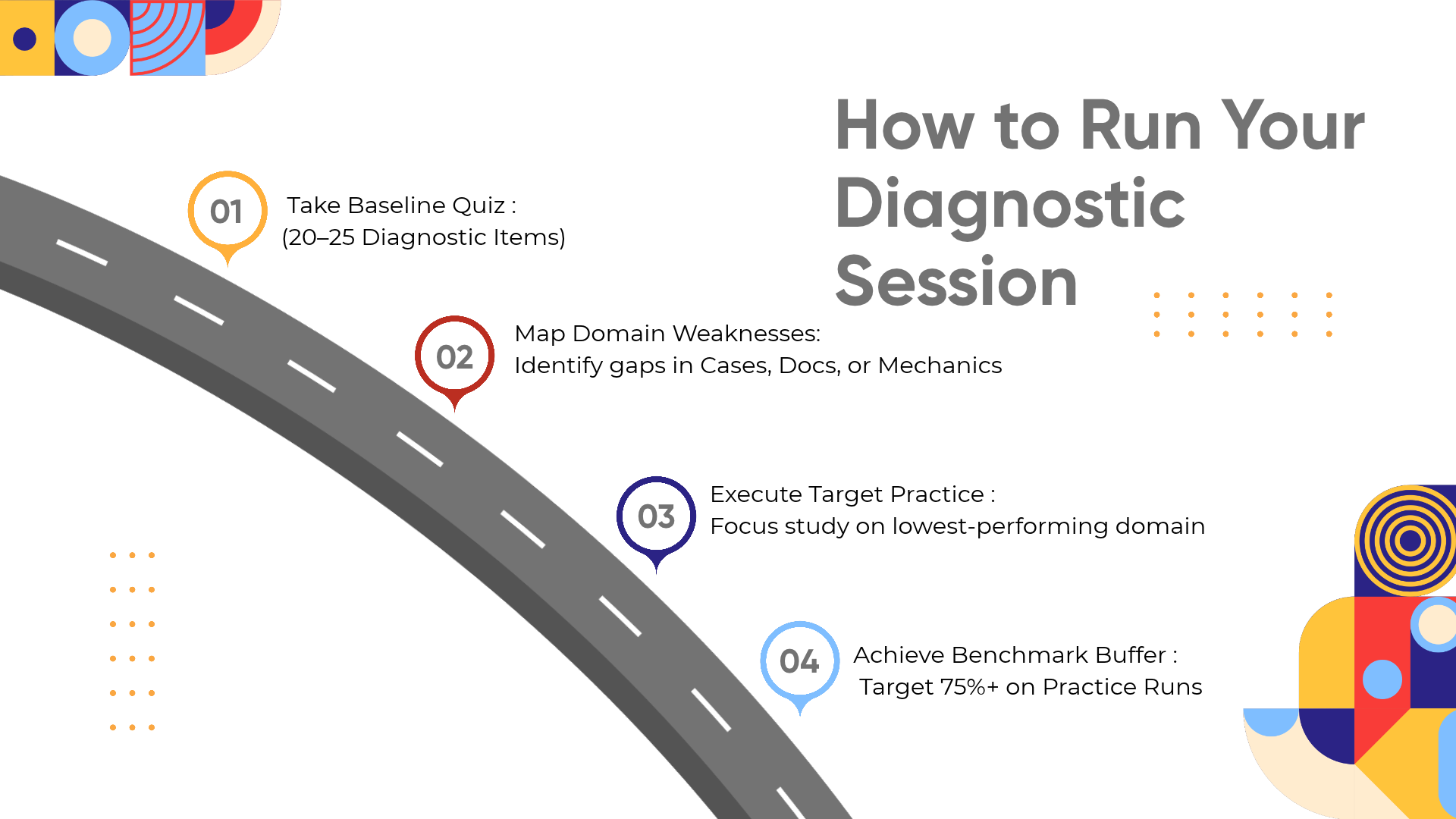
Take an Unassisted Diagnostic Quiz: Complete a short 20- to 25-question practice assessment without referring to study guides or notes.
Categorize Incorrect Responses: Log every missed question under its respective domain - Founding Documents, Landmark Cases, Constitutional Structure, or Democratic Principles.
Establish Your Target Buffer: While the FCLE passing threshold is 60%, your goal during practice runs should be a consistent 75% or higher (60/80 correct). Building a 15% safety buffer accounts for test-day anxiety and unexpected item variations.
Section 3: Domain-by-Domain Practice Breakdown with Rationales
To master the FCLE, you must study not only the correct answers, but also the reasoning that eliminates wrong choices. Below are representative practice items from each testing domain.
Domain 1: American Democracy & Principles
Practice Item 1
"Government of the people, by the people, for the people..."
Which foundational democratic principle is best reflected in this excerpt from Abraham Lincoln’s Gettysburg Address?
A) Federalism
B) Popular Sovereignty
C) Executive Privilege
D) Judicial Review
Correct Answer: B) Popular Sovereignty
Detailed Rationale: Popular sovereignty is the principle that the authority of a state and its government is created and sustained by the consent of its people, through their elected representatives. Lincoln's phrasing directly emphasizes that power originates from the citizens.
Distractor Breakdown:
A is incorrect: Federalism refers to the division of power between national and state governments.
C is incorrect: Executive privilege relates to the President's power to withhold certain confidential communications.
D is incorrect: Judicial review is the court system's power to declare laws unconstitutional (Marbury v. Madison).
Domain 2: U.S. Constitution & Structural Mechanics
Practice Item 2
If Congress passes a bill and the President vetoes it, which action can Congress take to enact the bill into law?
A) Petition the Supreme Court for an emergency injunction.
B) Re-vote and pass the bill with a two-thirds majority in both houses.
C) Issue an executive order through the Speaker of the House.
D) Submit the legislation to state governors for ratification.
Correct Answer: B) Re-vote and pass the bill with a two-thirds majority in both houses.
Detailed Rationale: Under Article I, Section 7 of the U.S. Constitution, the system of checks and balances allows Congress to override a presidential veto if both the Senate and the House of Representatives pass the bill by a two-thirds supermajority vote.
Distractor Breakdown:
A is incorrect: The judiciary cannot intervene in legislative drafting or veto overrides.
C is incorrect: Executive orders are strictly presidential actions, not congressional mechanisms.
D is incorrect: State governors have no constitutional role in federal legislative enactment.
Domain 3: Founding Documents & Historical Context
Practice Item 3
"In a pure democracy, a small group of citizens assemble and administer the government in person... hence it is that such democracies have ever been spectacles of turbulence and contention."
Who wrote this passage in Federalist No. 10 to argue in favor of a large constitutional republic over a direct democracy?
A) Thomas Jefferson
B) James Madison
C) Patrick Henry
D) George Washington
Correct Answer: B) James Madison
Detailed Rationale: James Madison authored Federalist No. 10, arguing that a well-constructed republic (a representative democracy) is superior to a pure (direct) democracy because it better controls the dangerous effects of "factions."
Distractor Breakdown:
A is incorrect: Thomas Jefferson was the principal author of the Declaration of Independence, not the Federalist Papers.
C is incorrect: Patrick Henry was a prominent Anti-Federalist who opposed the strong central government proposed in the Constitution.
D is incorrect: George Washington presided over the Constitutional Convention but did not contribute to the Federalist Papers.
Domain 4: Landmark Supreme Court Cases
Practice Item 4
A high school administration suspends students for wearing black armbands in protest of a war, even though the protest was peaceful and caused no disruption to instruction. Which Supreme Court decision establishes that this suspension violates the students' rights?
A) Hazelwood School District v. Kuhlmeier
B) Tinker v. Des Moines Independent Community School District
C) New Jersey v. T.L.O.
D) District of Columbia v. Heller
Correct Answer: B) Tinker v. Des Moines Independent Community School District
Detailed Rationale: In Tinker v. Des Moines (1969), the Supreme Court ruled that students do not "shed their constitutional rights to freedom of speech or expression at the schoolhouse gate." Symbolic, non-disruptive speech is protected under the First Amendment.
Distractor Breakdown:
A is incorrect: Hazelwood v. Kuhlmeier allowed schools to censor school-sponsored newspapers if related to legitimate pedagogical concerns.
C is incorrect: New Jersey v. T.L.O. addressed Fourth Amendment search and seizure standards on school grounds.
D is incorrect: DC v. Heller affirmed individual Second Amendment rights to keep firearms in the home for self-defense.
Section 4: High-Yield Practice Cheat Sheets & Keyword Tactics
When answering multiple-choice civics questions, associating trigger keywords with key constitutional concepts and Court precedents will dramatically improve your speed and accuracy.
High-Frequency Supreme Court Precedents
Landmark Court Case | Core Constitutional Issue | Primary Keyword Association |
Marbury v. Madison (1803) | Article III / Judicial Authority | Judicial Review (power to strike down unconstitutional laws) |
McCulloch v. Maryland (1819) | Article I / Necessary & Proper Clause | Federal Supremacy / Implied Powers |
Dred Scott v. Sandford (1857) | Citizenship & Due Process | Property Rights / Struck down Missouri Compromise |
Plessy v. Ferguson (1896) | 14th Amendment Equal Protection | "Separate but Equal" doctrine |
Brown v. Board of Education (1954) | 14th Amendment Equal Protection | Desegregation (overturned Plessy) |
Gideon v. Wainwright (1963) | 6th Amendment / Right to Counsel | State-provided Attorney for indigent defendants |
Miranda v. Arizona (1966) | 5th & 6th Amendments | Self-Incrimination Warning / Custodial Interrogation |
Tinker v. Des Moines (1969) | 1st Amendment Free Speech | Symbolic Student Speech / Armbands |
Roe v. Wade (1973) | 14th Amendment Due Process | Right to Privacy / Abortion rights frameworks |
United States v. Nixon (1974) | Article II / Executive Power | Rule of Law / Executive privilege is not absolute |
Hazlewood v. Kuhlmeier (1888) | 1st Amendment Free Press | School Newspaper Censorship |
District of Columbia v. Heller (2008) | 2nd Amendment Right to Bear Arms | Individual Gun Ownership for self-defense |
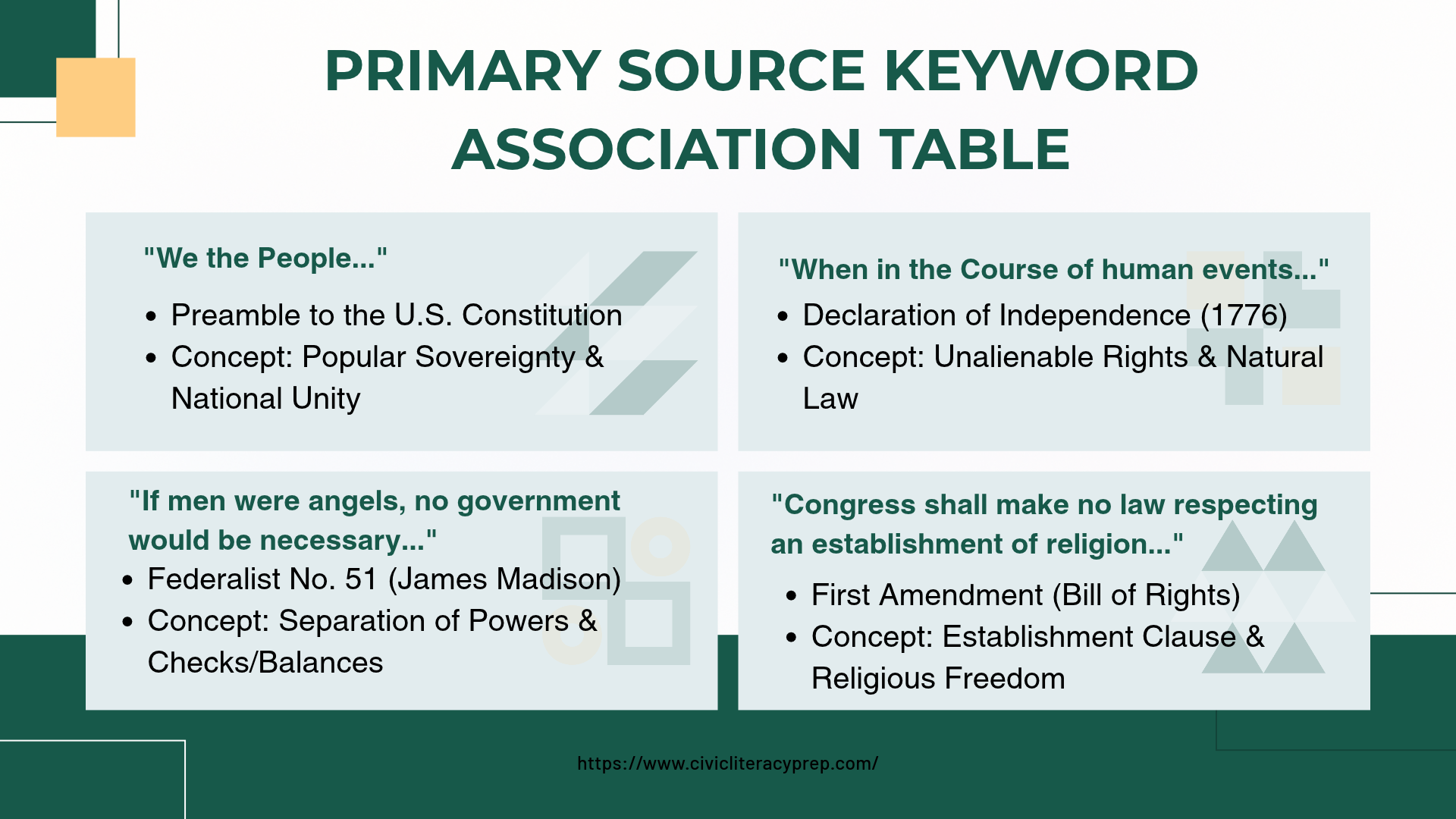
Primary Source Keyword Association Table
Use these textual clues to identify primary sources when working through excerpt-based questions:
Section 5: Advanced Test-Taking Tactics & Elimination Techniques
Knowing the historical facts is only half the battle. Applying an effective multiple-choice strategy will help you navigate tricky options on test day.
Strategy 1: The "Factually True, Promptly False" Distractor Trap
Test writers frequently include answer choices that state a completely true historical fact, but fail to answer the specific question asked.
Example: If a prompt asks which power belongs exclusively to the House of Representatives, an option might read: "The Senate approves presidential cabinet appointments."
Tactical Response: While factually correct, the statement describes a Senate power, not a House power. Always double-check whether the choice directly satisfies the prompt's condition.
Strategy 2: Absolute Language Red Flags
Be cautious of distractor choices containing radical absolute terms such as "always," "never," "solely," or "unrestricted."
Example: "The First Amendment guarantees absolute, unrestricted freedom of speech under all circumstances."
Tactical Response: Rights guaranteed by the Constitution are subject to legal limitations e.g., speech inciting imminent lawless action is not protected under Brandenburg v. Ohio. Options containing extreme absolute language are almost always incorrect.
Strategy 3: The "Rationale-First" Review Method
When taking practice tests, never simply mark an answer wrong and move on. Force yourself to complete a three-step review for every missed item:
State the Correct Answer: Identify the correct option.
Explain the Fallacy: Verbally state or write down why your initial choice was incorrect.
Isolate the Trigger: Locate the specific word or phrase in the question stem that should have led you to the correct principle.
Section 6: Recommended Official Practice Resources & Study Blueprint
To ensure you are practicing with high-quality, aligned materials, rely on official state and institutional resources.
Verified Practice Portals
Florida Department of Education FCLE Resources: The official state repository containing sample items, competency breakdowns, and test specifications.
Eastern Florida State College FCLE Study Guide: Comprehensive institutional review portals featuring organized study sheets, key court case summaries, and self-assessment quizzes.
Valencia College Civic Literacy Assessment Prep: Practice modules focusing on constitutional mechanics and landmark judicial decisions.
Civic Literacy Prep : Incorporates all questions ina clean formatted manner to make sure the content you have is tested property on all the 4 competencies.
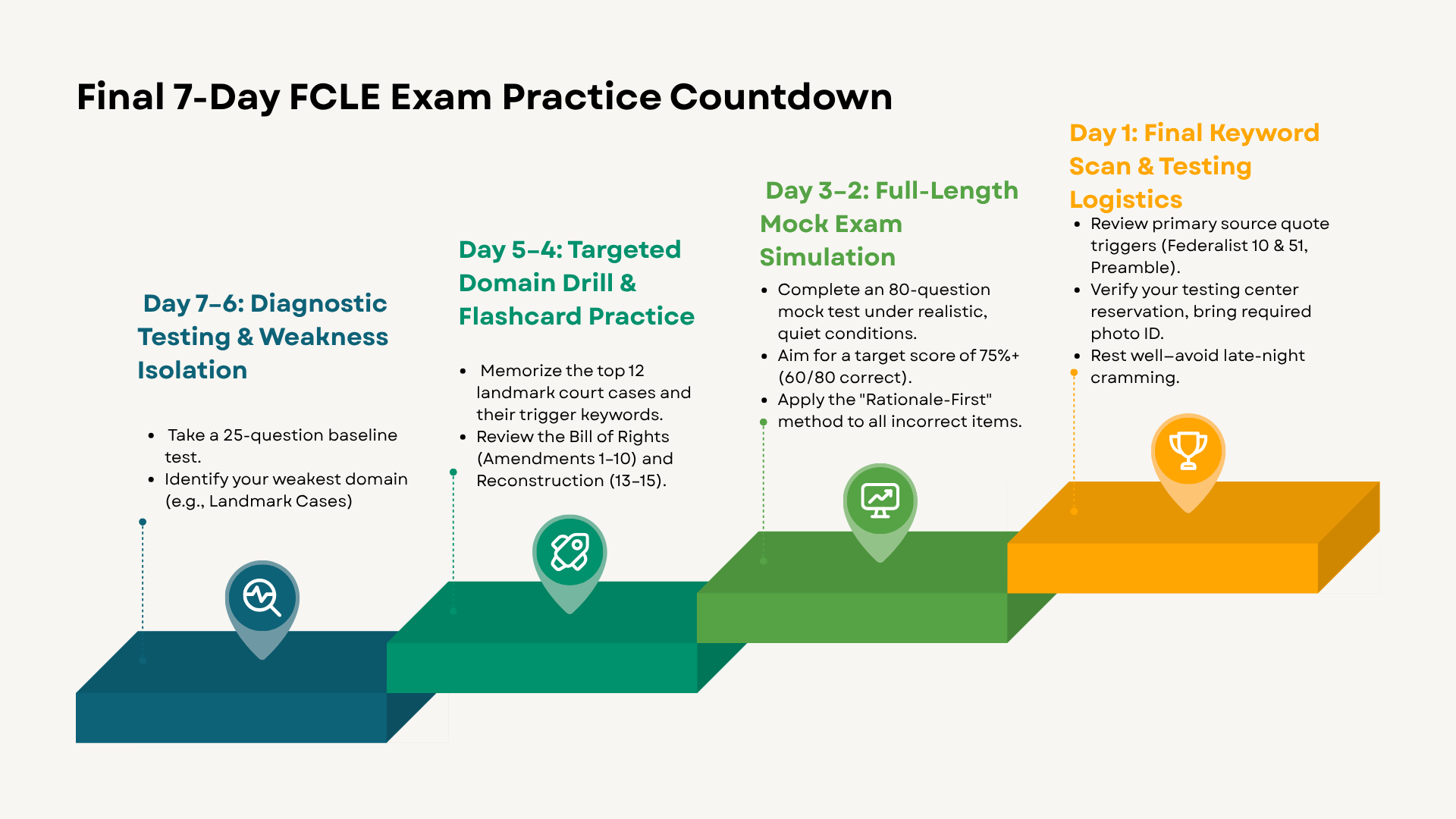
Final 7-Day FCLE Exam Practice Countdown
Final Thoughts from a Civic Educator
The Florida Civic Literacy Exam is not designed to trick you; it is structured to ensure that every postsecondary graduate possesses a functional understanding of the rights, responsibilities, and legal foundations that shape our nation.
By shifting your preparation from passive reading to active FCLE exam practice, focusing on primary sources, and deconstructing landmark court decisions, you will enter the testing center with confidence.
Take control of your prep, execute your diagnostic workflow, and earn the score you need to fulfill your Florida graduation requirement!